
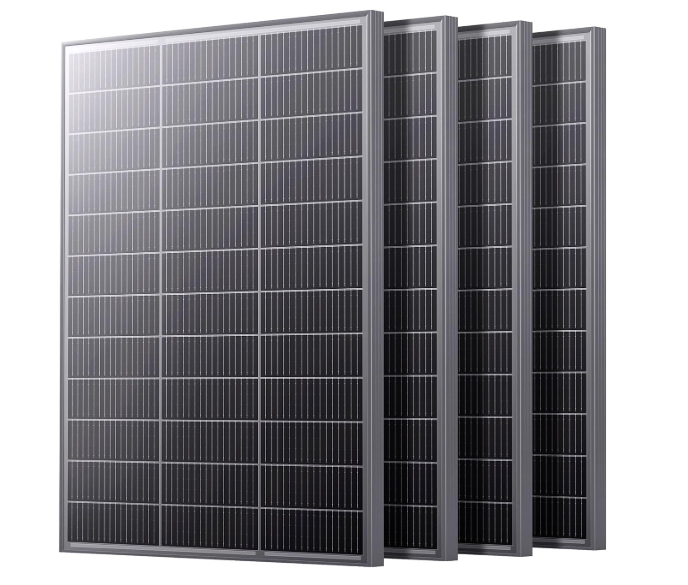
Choosing the best solar panel for a camper van can make off grid travel more convenient by providing a dependable way to generate electricity for batteries, devices, and other compatible equipment. The best options combine efficient solar cells, suitable power output, portability, simple setup, adjustable positioning, and durable construction that can handle outdoor conditions.
Portable and foldable designs are especially useful for travelers who want flexible power without permanent installation. In this guide, you will learn about the important features to look for, explore the top picks, understand the key factors to consider before buying, and find answers to common questions in the FAQs.
Best Solar Panel for Camper Van
1)ECO-WORTHY 200 Watts 12 Volt/24
Get it on Amazon
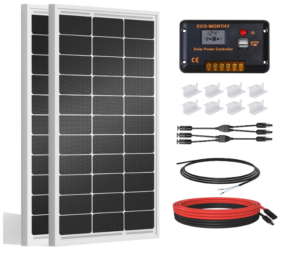
The ECO WORTHY 200 Watt 12 Volt/24 Volt solar panel kit is a practical option for camper vans, RVs, caravans, and other mobile setups that need dependable off grid power. The kit includes two 100W monocrystalline solar panels, making it possible to build a 12V or 24V system depending on how the panels are connected. With an advertised daily output of up to 800Wh under four hours of full sunshine, it can provide useful energy for lights, small appliances, electronics, and other camper van essentials.
The use of monocrystalline solar cells gives this system good energy conversion performance, with efficiency of up to 21.5% under suitable lighting conditions. This makes the panels a useful choice when roof space is limited and you want to get a reasonable amount of power from a relatively compact installation. Each panel measures approximately 35.2 by 23.1 by 1.37 inches, giving camper van owners a manageable size to work with when planning their roof layout.
Durability is another advantage for mobile use. The corrosion resistant aluminum alloy frame is designed for long term outdoor exposure and can withstand wind loads of up to 2400Pa and snow loads of up to 5400Pa. The IP65 rated junction box also provides protection against dust and water exposure. These features make the panels suitable for outdoor applications where they may regularly encounter changing weather conditions.
Installation is relatively straightforward because the panels come with pre drilled holes, mounting brackets, cables, and connectors. The included 30A solar controller helps simplify the setup, while the Z mounting brackets provide a way to secure the panels to a camper van or other suitable surface. The system can be connected in parallel for a 12V setup or in series for a 24V configuration, giving users some flexibility depending on their power requirements.
The kit also comes with a pair of 16.4 foot 10 AWG solar cables, a pair of 2 in 1 connectors, and a pair of 4.92 foot tray cables. Having these components included can reduce the need to purchase several installation accessories separately. For camper van owners who want a complete starting package rather than individual panels alone, this makes the ECO WORTHY kit convenient.
Its wide application range adds to its versatility. Beyond camper vans, it can be used with RVs, caravans, boats, golf carts, electric scooters, trolling motors, tool trailers, cabins, sheds, and backup power systems. For a camper van, the ability to generate renewable power while parked away from electrical hookups can be particularly useful during camping trips and extended stays off the grid.
One point to keep in mind is that the advertised 800Wh daily output depends on receiving about four hours of full sunshine. Actual production will vary according to sunlight intensity, weather, panel positioning, shading, temperature, and the condition of the system. The 200W panel capacity also means it is better suited to modest camper van electrical needs than to running numerous high power appliances continuously.
ECO WORTHY also provides one year of support with 24/7 technical assistance. This can be helpful for users who need guidance during installation or have questions about operating the system. Overall, the combination of two monocrystalline panels, mounting hardware, cables, connectors, and a solar controller makes this a convenient package for anyone looking for a solar power setup for a camper van.
Pros
• Two 100W monocrystalline solar panels provide 200W of total rated power
• Up to 21.5% efficiency under suitable lighting conditions
• Can be configured for either 12V or 24V systems
• Includes a 30A solar controller
• Includes mounting brackets, solar cables, connectors, and tray cables
• Corrosion resistant aluminum alloy frames
• Designed to withstand substantial wind and snow loads
• IP65 rated junction box
• Suitable for camper vans, RVs, caravans, marine applications, and backup power
• One year support with 24/7 technical assistance
Cons
• The advertised 800Wh daily output depends on four hours of full sunshine
2)N-Type 16BB 400 Watt Solar Panel, 4×100W Solar Panels
Get it on Amazon
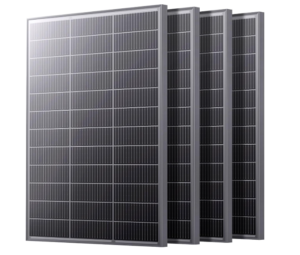
The Callsun N Type 16BB 400 Watt Solar Panel is a strong option for camper van owners who want substantial solar capacity without relying on large, traditional panels. The system consists of four 100W monocrystalline panels, providing a combined 400W of rated power. Its N type cell technology is designed to deliver up to 25% conversion efficiency, making it suitable for camper vans, RVs, boats, cabins, and other off grid applications where dependable solar generation is important.
One of the main advantages of this system is its 16 busbar design. Compared with conventional 9BB or 10BB panels, the 16BB configuration is designed to improve light absorption while reducing the risk of hot spots and micro cracks. For a camper van, this can contribute to more consistent power production and better long term reliability, especially when the panels are exposed to changing outdoor conditions.
Each 100W panel measures 31.1 by 22.7 by 1.1 inches and weighs 11.4 pounds. Callsun states that the panels are about 15% smaller than traditional panels, which can be useful when roof space is limited. The pre drilled mounting holes also make installation easier, allowing the panels to be positioned securely on a suitable camper van roof or other mounting surface.
The panels are particularly well suited to warmer environments because of their low temperature coefficient of minus 0.3% per degree Celsius. Solar panels can experience reduced output as temperatures rise, so this design is intended to limit power losses in hot weather. For camper van owners traveling through sunny and hot regions, this can help maintain more stable energy production during periods of intense heat.
Durability is another reason to consider this 400W system for mobile use. The panels use 3.2mm low iron tempered glass and corrosion resistant aluminum alloy frames. They also have IP68 waterproof protection and reinforced corner guards. The panels are designed to withstand wind loads of up to 2400Pa and snow loads of up to 5400Pa, providing protection against demanding outdoor conditions.
The four panel configuration also gives camper van owners flexibility when planning their solar installation. Instead of depending on one large panel, the 400W system spreads the total capacity across four smaller panels. This can make it easier to work around roof accessories, vents, storage areas, or other obstacles. However, buyers should carefully measure their available roof space and check the electrical specifications before ordering to ensure the system is compatible with their charge controller, battery bank, and other components.
For long term use, Callsun provides 10 years of technical support for materials and workmanship and a 25 year performance guarantee that maintains 84.5% power output. The claimed service life of up to 30 years also makes the panels appealing to camper van owners planning frequent or extended off grid travel. Overall, the combination of N type cells, 16BB technology, compact individual panels, heat performance, and strong weather protection makes this a capable choice for a higher capacity camper van solar setup.
Pros
• 400W total power from four 100W monocrystalline panels
• N type technology with up to 25% conversion efficiency
• 16BB design helps improve light absorption
• Designed to reduce hot spots and micro cracks
• Individual panels are relatively compact for easier roof placement
• Pre drilled mounting holes simplify installation
• Low temperature coefficient helps reduce power loss in high temperatures
• 3.2mm low iron tempered glass construction
• Corrosion resistant aluminum alloy frames
• IP68 waterproof protection
• Designed to withstand strong wind and snow loads
• 10 years of technical support
• 25 year performance guarantee with 84.5% power output
Cons
• Four separate panels require careful planning for roof placement
3)Renogy 200W 12V N-Type RV
Get it on Amazon
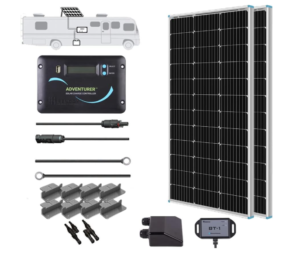
The Renogy 200W 12V N Type solar panel is a practical choice for camper van owners who need reliable solar power while keeping their installation relatively compact. With a claimed daily output of up to 800Wh when four hours of sunlight are available, this system can provide useful energy for lighting, electronics, small appliances, and other everyday camper needs. It is also suitable for RVs, caravans, boats, greenhouses, and other off grid applications.
The panel offers 22% solar cell efficiency, which provides good energy production when adequate sunlight is available. For camper vans, efficiency is especially useful because roof space is often limited. The design allows users to generate useful power without requiring an excessively large installation area.
Durability is another benefit for outdoor and mobile applications. The corrosion resistant aluminum frame is designed for long term outdoor use and can withstand wind loads of up to 2400Pa and snow loads of up to 5400Pa. The panel also has an IP67 protection rating when mated, while its operating temperature range of minus 40°F to 194°F makes it suitable for a wide variety of weather conditions.
The included Renogy Adventurer Li 30A PWM charge controller adds useful protection to the system. It is designed for flush mounting on an RV or camper wall, giving the installation a cleaner appearance. The controller provides protection against overcharging, overload, short circuit, and reverse polarity, helping protect the connected solar system and batteries.
Installation is designed to be straightforward thanks to the pre drilled mounting holes and Plug and Play cables. The system supports lithium, lead acid, and gel batteries, giving camper van owners flexibility when choosing their battery technology. Three pairs of Y branch connectors are also included to support parallel connections when additional panels are added to the system.
Renogy also backs the product with a five year warranty and 24/7 technical support. This can be useful for camper van owners who want assistance with installation, configuration, or troubleshooting. Overall, the Renogy 200W 12V N Type solar panel offers a balanced combination of efficiency, durability, battery compatibility, installation convenience, and protection for camper van solar applications.
Pros
• 200W solar power capacity
• Up to 22% solar cell efficiency
• Advertised daily output of up to 800Wh with four hours of sunlight
• Corrosion resistant aluminum frame
• Designed to withstand 2400Pa wind loads and 5400Pa snow loads
• IP67 protection rating when mated
• Includes a 30A PWM charge controller
• Protection against overcharging, overload, short circuit, and reverse polarity
• Supports lithium, lead acid, and gel batteries
• Pre drilled holes and Plug and Play cables simplify installation
• Three pairs of Y branch connectors support parallel connections
• Five year warranty
• 24/7 technical support
Cons
• The 800Wh daily output depends on receiving four hours of suitable sunlight
4)Movsunpv 200W Portable Solar Panel
Get it on Amazon
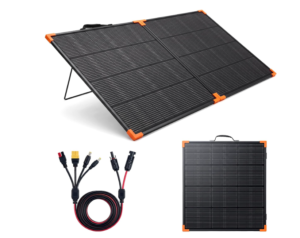
The 200W Portable Solar Panel is a convenient option for camper van owners who want portable solar power without committing to a permanent roof mounted installation. Its foldable design makes it easier to transport, position, and store when it is not being used. The panel is designed for off grid adventures, RV boondocking, overlanding, camping, and emergency backup applications.
This panel uses advanced N Type monocrystalline solar cells with 16 busbars and offers conversion efficiency of up to 25%. The N Type design is intended to reduce internal resistance and avoid Light Induced Degradation, helping the panel maintain strong performance over time. It can also capture useful energy in lower light conditions, although direct unobstructed sunlight will provide the fastest and highest power production.
The adjustable kickstands make positioning the panel convenient when camping. The four reinforced kickstands allow the panel to be angled up to 45 degrees toward the sun, which can help it collect more sunlight than when placed completely flat. This flexibility is particularly useful for camper van users who can position the panel outside the vehicle and adjust it throughout the day.
Durability is another useful quality for outdoor travel. The panel has an ETFE coated surface designed to provide resistance to dust and weather exposure, along with an IP67 waterproof rating. This gives it protection against rain and dust during outdoor use. The reinforced construction also makes it suitable for demanding applications such as RV camping, overlanding, and emergency power situations.
Connectivity is designed to be flexible for different portable power stations. The included 4 in 1 solar cable provides XT60, DC5521, DC7909, and Anderson connectors, allowing the panel to work with a wide range of compatible power stations and portable generators. This can be particularly helpful for camper van owners who want to power equipment such as a camping fridge or recharge a portable power station without purchasing several different cables.
Although the panel can still generate electricity on cloudy days or when some shading is present, its output will be significantly lower than under direct sunlight. For the best results, users should place it where sunlight is unobstructed and adjust the angle as needed. This is an important consideration for camper van owners because trees, nearby vehicles, buildings, and other obstacles can reduce solar production.
Overall, the 200W Portable Solar Panel is a versatile choice for camper van users who value portability and flexible positioning. Its N Type cells, 16 busbar design, high efficiency, adjustable kickstands, waterproof construction, and broad connector compatibility make it suitable for a variety of off grid power needs. Its portable design also allows it to complement a permanent solar system when additional power is needed.
Pros
• 200W rated solar power
• N Type monocrystalline solar cells
• Up to 25% conversion efficiency
• 16 busbar design helps reduce internal resistance
• Designed to minimize Light Induced Degradation
• Foldable and portable design
• Four adjustable reinforced kickstands
• Can be positioned at an angle of up to 45 degrees
• ETFE coated surface provides weather and dust resistance
• IP67 waterproof rating
• Includes a 4 in 1 solar cable
• Supports XT60, DC5521, DC7909, and Anderson connectors
• Compatible with many high capacity portable power stations
• Suitable for camper vans, RVs, overlanding, and emergency backup
Cons
• Solar output drops significantly in cloudy or shaded conditions
5)Renogy 100W Portable Solar Panel
Get it on Amazon
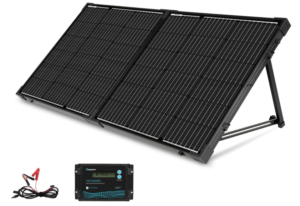
The Renogy 100W Portable Solar Panel is a practical option for camper van owners who want portable solar power without dealing with a permanent installation. Its foldable suitcase style makes it easy to carry, store, and set up at a campsite or remote location. At 17.42 pounds, it offers a useful balance between portability and power for travelers who need a convenient charging solution.
This solar panel uses N Type solar cells with up to 25% conversion efficiency, allowing it to make good use of available sunlight. The panel is designed to perform well in low light conditions, although stronger direct sunlight will provide better results. With five hours of sunlight, it can produce up to 500Wh per day under suitable conditions. The adjustable aluminum alloy kickstand also allows you to position the panel toward the sun to improve daily energy production.
For camper van use, the foldable design is especially convenient. Instead of requiring a permanent roof installation, the panel can be unfolded when you need power and stored away when traveling. This makes it useful for camping, RV trips, off road adventures, and remote stays where flexible power generation is important.
The plug and play setup is another useful advantage. The panel comes with a pre installed waterproof 20A PWM charge controller and alligator clip cables, so users do not have to source several separate components before getting started. Its four stage charging technology is designed to improve charging efficiency while helping extend battery life. It works with 12V portable power stations as well as Gel, AGM, Flooded, and Lithium batteries.
Durability is also well suited to outdoor travel. Low iron tempered glass provides structural strength, while the anti corrosion aluminum frame helps the panel withstand outdoor exposure. The IP65 rated junction box provides protection against dust and water, while the panel is designed to handle rain, snow, dust, and hail. Bypass diodes in the junction box help reduce power losses and limit the effects of hotspots during operation.
Overall, the Renogy 100W Portable Solar Panel combines useful efficiency, easy setup, portability, and outdoor durability in a compact package. For camper van users who prefer a portable system that can be deployed when needed rather than permanently mounted, it provides a convenient way to generate solar power during camping and travel.
Pros
• Up to 25% conversion efficiency with N Type cells
• Can produce up to 500Wh per day with five hours of sunlight under suitable conditions
• Adjustable aluminum alloy kickstand helps position the panel toward the sun
• Foldable suitcase design makes transportation and storage easier
• Plug and play setup with a pre installed waterproof 20A PWM charge controller
• Four stage charging technology helps improve charging efficiency and battery life
• Compatible with 12V portable power stations and several battery types
• Low iron tempered glass provides good structural strength
• Anti corrosion aluminum frame is suitable for outdoor use
• IP65 rated junction box provides protection against dust and water
• Bypass diodes help reduce power losses and hotspot effects
• Includes a 5 year materials and workmanship warranty
Cons
• At 17.42 pounds, it may still feel heavy for some users who prioritize ultralight camping gear
You may also like to read Best Golfing Laser Range Finder
Best Solar Panel for Camper Van Advantages
1. High Energy Efficiency
A high efficiency solar panel can produce more electricity from the available sunlight, making it useful when roof or campsite space is limited. Efficient solar cells can also perform reasonably well during less than ideal lighting conditions, helping you collect useful energy throughout the day.
2. Easy Portability
Portable solar panels are convenient for camper van travel because they can be folded, carried, stored, and set up whenever power is needed. This flexibility is particularly useful when you do not want to permanently mount panels on the vehicle.
3. Simple Setup
A camper van solar panel with a straightforward setup saves time and reduces the need for complicated wiring. Plug and play designs with included charging components allow users to connect their panels to compatible batteries or power stations with less preparation.
4. Adjustable Positioning
An adjustable stand allows the panel to be tilted toward the sun instead of remaining flat. Proper positioning can improve sunlight exposure and help increase the amount of electricity produced during the day.
5. Outdoor Durability
Camper van solar panels need to withstand changing outdoor conditions because they are commonly used during camping and road trips. Durable materials such as tempered glass and corrosion resistant aluminum can provide better protection against rain, dust, snow, and other environmental conditions.
6. Battery Compatibility
Choosing a panel that works with different battery types gives you greater flexibility when building a camper van power system. Compatibility with portable power stations and common battery technologies makes it easier to create a setup that matches your existing equipment.
7. Reduced Power Loss
Features such as bypass diodes can help reduce power losses and limit the impact of hotspots when parts of the panel receive different amounts of sunlight. This can help maintain more consistent energy production during outdoor use.
8. Convenient Off Grid Power
Solar power allows camper van users to generate electricity without depending entirely on campsite electrical hookups. A suitable panel can provide energy for charging devices, maintaining batteries, and supporting other compatible equipment while traveling or staying in remote locations.
Factors to Consider When Choosing the Best Solar Panel for Camper Van
1. Power Output
Consider the amount of electricity you need each day before choosing a solar panel. A higher wattage system can provide more energy for charging batteries and running compatible appliances, while a smaller panel may be sufficient for basic needs such as charging phones, lights, and small devices.
2. Solar Cell Efficiency
Solar cell efficiency determines how effectively the panel converts available sunlight into electricity. Higher efficiency can be especially useful on a camper van where roof or storage space is limited. Efficient cells can help generate more usable power from a relatively compact panel.
3. Portability and Size
If you plan to move between different campsites, consider how easy the panel is to carry and store. A lightweight foldable design can be convenient because it can be transported inside the camper van and set up only when solar power is required.
4. Ease of Installation
Look for a solar panel system that matches your level of technical experience. A simple setup with included cables and a suitable charge controller can reduce installation work and make it easier to begin generating power without purchasing numerous additional components.
5. Battery Compatibility
Check that the solar panel and its charging equipment are compatible with your existing battery or power station. Different systems may support Lithium, AGM, Gel, Flooded, or other battery types, so confirming compatibility can help prevent charging problems.
6. Durability and Weather Resistance
Since camper van solar panels are exposed to outdoor conditions, durability is an important consideration. Tempered glass, corrosion resistant frames, and suitable water and dust protection can help the panel withstand rain, dust, snow, hail, and regular outdoor use.
7. Adjustability and Sunlight Positioning
A panel with an adjustable stand can be positioned toward the sun to improve exposure throughout the day. This is particularly useful with portable systems because you can change the angle as the sun moves and potentially increase daily energy production.
8. Warranty and Long Term Support
Consider the warranty and customer support provided with the solar panel. A longer materials and workmanship warranty can provide greater confidence in the system, while accessible technical support can be useful when troubleshooting charging, connections, or performance issues during your travels.
Best Solar Panel for Camper Van FAQS
1. What size solar panel is best for a camper van?
The right size depends on your daily electricity needs and the appliances or devices you plan to power. A 100W panel can be suitable for basic charging needs, while larger systems may be better for powering multiple devices and maintaining larger battery banks.
2. Are portable solar panels good for camper vans?
Yes, portable solar panels are a convenient choice for camper vans because they can be unfolded and positioned in direct sunlight when needed. They are also easy to store when traveling and do not require permanent roof installation, making them useful for flexible camping setups.
3. What should I look for in a camper van solar panel?
Look for good solar efficiency, suitable power output, portability, durable construction, weather resistance, easy setup, battery compatibility, and a reliable warranty. An adjustable stand can also be useful because it allows you to position the panel toward the sun for better energy production.
Conclusion
The best solar panel for a camper van should offer more than just a high power rating. It should combine efficient energy production, convenient portability, simple setup, adjustable positioning, battery compatibility, and durable construction for dependable outdoor use.
A well chosen panel gives travelers greater freedom to generate electricity away from traditional power sources while keeping the system practical to carry and store. What makes the best options different from the rest is their ability to balance reliable performance with flexibility, allowing camper van users to enjoy convenient solar power wherever their journey takes them.