
Finding the best power bank for camping with a solar panel means choosing a portable power solution that can provide dependable energy while you are away from traditional outlets. The options discussed here stand out for their combination of large battery capacities, high power outputs, solar charging capability, multiple charging methods, durable battery technology, and useful connections for camping and RV equipment.
Whether you need to keep a refrigerator, lights, WiFi router, phones, laptops, or larger appliances running, these solar power stations offer different levels of capacity and portability to suit various outdoor needs. In this guide, we will cover the important features to look for, explore the top picks, provide a practical buying guide to help you choose the right system for your camping setup, and answer frequently asked questions about using solar powered power banks outdoors.
Best Camping Solar Power Bank
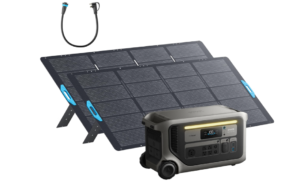
1)Anker SOLIX F3000 Portable Power Station paired with two 400W solar panels
Get it on Amazon
The Anker SOLIX F3000 Portable Power Station paired with two 400W solar panels is designed for campers who need substantial, dependable power away from the grid. Its 3kWh starting capacity provides enough energy to keep essential appliances running for extended periods, while the included solar panels provide a practical way to recharge outdoors. With a powerful 3,600W pass through capability, 2,400W solar input, and support for 120V and 240V output, it can handle considerably more demanding camping setups than a basic portable power bank. Battery expansion up to 24kWh also gives users the flexibility to build a much larger off grid power system for longer trips.
One of its useful advantages for camping is its low idle power consumption. The F3000 can provide up to 125 hours of AC idle standby time, helping reduce unnecessary battery drain when connected equipment is not actively drawing much power. Anker also states that it can run a 190W refrigerator for up to 42 hours, making it suitable for keeping food and drinks cold during extended outdoor stays. This makes the system particularly practical for campers who rely on refrigerators, lights, fans, cooking equipment, and other essential devices.
The included two 400W solar panels complement the F3000’s high solar charging capability. The power station can accept up to 2,400W of solar input through its 165V or 60V ports, allowing it to recharge much faster than smaller solar power banks when sufficient sunlight and compatible panels are available. Having two 400W panels in the package also gives campers a convenient starting setup without needing to purchase solar panels separately.
For users bringing more demanding appliances to a campsite, the F3000 offers powerful 120V output and can be paired with a second power station to provide 240V power. This gives the system greater flexibility for equipment that requires higher voltage. Its 3,600W pass through charging capability also allows appliances to continue operating while the unit is being recharged with a 120V generator, which can be useful when camping during poor weather or when solar conditions are limited.
The expandable battery capacity is another reason this system can work well for extended camping. The starting 3kWh capacity can be expanded to as much as 24kWh, allowing users to build a considerably larger energy reserve over time. Anker states that the system can provide up to 10 hours of power from its starting capacity and as much as 80 hours with expanded battery capacity, depending on the appliances being powered and their energy consumption.
Charging flexibility is another major benefit. In an emergency, the F3000 supports up to 6,000W of combined charging when fuel generation and solar charging are used together. It can also be configured to automatically store available solar energy or take advantage of lower off peak electricity rates when paired with Anker’s Bi Directional Inlet Box and Smart Meter. This gives the system uses beyond ordinary camping and makes it suitable for backup power applications as well.
The package includes the Anker SOLIX F3000 Portable Power Station, two Anker SOLIX PS400 Portable Solar Panels, an AC charging cable, a high voltage solar charging cable, user manual, warning notice, and warranty card. Having the panels and necessary charging cables included makes the package more complete for campers who want to start using solar charging without assembling a system from several separate purchases.
However, this is a large capacity power system rather than a lightweight power bank for short day trips. Its high output and expandable battery design are most useful for campers who regularly need to operate several appliances or spend extended periods away from conventional electricity. The solar panels also depend on available sunlight, so charging performance will vary with weather, positioning, and solar conditions. The advanced features and large capacity may also be more than necessary for campers who only need to charge phones, cameras, or small USB devices.
Pros
• 3kWh starting capacity provides substantial energy for camping
• Includes two 400W solar panels for convenient outdoor recharging
• Supports up to 2,400W of solar input
• Powerful 3,600W pass through charging capability
• Supports 120V output and 240V operation when paired with another unit
• Expandable battery capacity up to 24kWh
• Very long AC idle standby time of up to 125 hours
• Can run a 190W refrigerator for up to 42 hours according to Anker
• Supports extremely fast 6,000W combined solar and generator recharging
• Useful for both camping and home backup power
Cons
• Large capacity and high power output make it more than some casual campers need
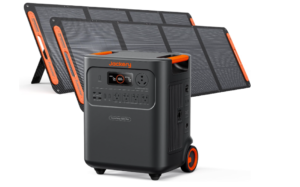
2)Jackery HomePower 3600 Plus with Extra Battery and two 200W solar panels
 Get it on Amazon
The Jackery HomePower 3600 Plus with Extra Battery and two 200W solar panels is a high capacity solar power system designed for campers who need more than basic phone and device charging. With 3,584Wh of capacity, 3,600W output, and the ability to expand its storage considerably, it can support larger camping setups with appliances such as refrigerators, heaters, pumps, and dryers. The included 2×200W solar panels provide 400W of solar charging capacity, making the package suitable for campers looking for a renewable way to replenish their power supply while outdoors.
The 3,600W output gives the HomePower 3600 Plus enough power for many demanding appliances, while parallel operation can increase output to 7,200W. It also supports 120V and 240V operation when units are connected in parallel. For longer camping trips, the 3,584Wh capacity can be expanded to 21kWh per unit, while multiple units can provide even more storage. This flexibility makes it possible to build a system around changing power requirements rather than being limited to the original battery capacity.
Battery durability is another important consideration for extended outdoor use. Jackery uses high temperature resistant ceramic membrane battery cells that have been tested at 302°F, with the design intended to reduce the risk of thermal runaway caused by heat or overcharging. The system is rated for up to 6,000 cycles and a 10 year lifespan. It is also designed to operate in temperatures as low as −4°F, giving it a broad operating range for different camping environments.
Charging flexibility makes the HomePower 3600 Plus particularly practical when access to electricity varies. Jackery states that hybrid AC and DC charging can take the battery from 0% to 100% in about two hours. It can also be charged through AC in approximately 2.5 hours, solar in about four hours, or a gas generator in around 2.5 hours. For camping, the solar option is especially useful because the included two 200W panels can provide an alternative to relying entirely on mains electricity or fuel.
The system is also designed to be easy to use. Its plug and play design allows users to connect their equipment, press the Power On button, and begin using the available energy. This can be convenient at a campsite where complicated installation is undesirable. Its compatibility with an MTS also allows it to be used as a backup power solution beyond camping, giving the system additional versatility for home use.
Despite its substantial capacity, Jackery emphasizes portability in the HomePower 3600 Plus design. It uses automotive grade CTB technology and is described as 34% smaller and 29.3% lighter than other comparable models. The luggage style design, wheels, and telescopic handle make it easier to move around a campsite, garage, kitchen, or other location than a stationary battery system. However, its overall size and capacity still make it better suited to serious camping and backup power needs than lightweight day trips.
The included two 200W solar panels are a useful addition for campers who want to recharge without depending entirely on the electrical grid. With 400W of combined panel capacity, the setup can replenish the power station during suitable sunlight conditions. Actual charging time will depend on sunlight intensity, panel positioning, weather, and energy consumption while charging, so campers should plan their power usage accordingly.
Overall, the Jackery HomePower 3600 Plus and Extra Battery package is built around high capacity, strong output, flexible charging, and expandable storage. Its combination of a 3,584Wh base capacity, extra battery, 400W of included solar panels, 3,600W output, and portable wheeled design makes it a substantial option for campers who operate several appliances or spend extended periods away from conventional power.
Pros
• 3,600W output provides substantial power for demanding camping appliances
• 3,584Wh starting capacity offers plenty of stored energy
• Includes an Extra Battery for greater energy storage
• Includes two 200W solar panels with 400W combined solar capacity
• Supports expansion up to 21kWh per unit
• Can deliver up to 7,200W when units are connected in parallel
• Supports 120V and 240V operation in parallel configurations
• Up to 6,000 battery cycles and a claimed 10 year lifespan
• Multiple charging options including AC, solar, hybrid AC and DC, and gas generator
• Hybrid AC and DC charging can reach full capacity in about two hours
• Wheels and telescopic handle make transportation easier
• Plug and play design simplifies operation
Cons
• 400W of included solar panel capacity may take longer to recharge the large battery than a higher wattage solar setup
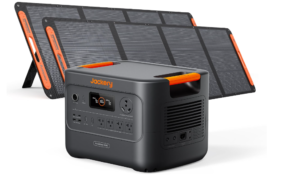
3)Jackery HomePower 3000 with two 200W SolarSaga panels
Get it on Amazon
The Jackery HomePower 3000 with two 200W SolarSaga panels is a high capacity camping solar power system designed for users who need enough energy to run more than small electronics. With a 3,072Wh battery and 3,600W AC output, it can handle appliances such as refrigerators, fans, lights, and WiFi equipment while also providing multiple charging options for smaller devices. The included 2×200W solar panels add 400W of solar generation, giving campers a practical way to recharge the power station when away from the grid.
With 3,600W of continuous output and up to 7,200W surge power, the HomePower 3000 can support demanding appliances that smaller portable power banks may not handle. Jackery states that its 3,072Wh capacity can power a household for up to 15 hours and keep a refrigerator running for one to two days, although actual runtime will depend on the appliance’s power consumption. For camping, this capacity is useful when running a refrigerator, lighting, fans, cooking equipment, or several smaller devices at the same time.
The built in UPS system adds another layer of usefulness for equipment that needs uninterrupted power. Jackery specifies a switching time of 20ms or less, allowing essential devices such as security cameras, pet feeders, refrigerators, and networking equipment to continue operating when the main electricity supply suddenly stops. This can also be helpful for campers using sensitive electronics where an unexpected interruption could be inconvenient.
The HomePower 3000 offers a wide selection of connection options. Its AC outlets can power larger appliances, while USB C and USB A ports handle phones, tablets, cameras, drones, and other portable electronics. The two 100W USB C PD ports provide faster charging for compatible devices, and the built in TT 30 RV port provides a convenient connection for RV equipment. This combination makes the unit useful for both traditional camping and RV trips.
Charging flexibility is another strong point. Jackery states that the HomePower 3000 can recharge from 0% to 100% in about 1.7 hours using hybrid AC and DC charging, while AC charging alone takes about 2.2 hours. When paired with two SolarSaga 200W panels, it can reach up to 80% charge in about nine hours under suitable conditions. It can also be recharged from a 12V car outlet or gas generator, giving campers alternatives when solar conditions are poor.
The battery system uses LiFePO4 cells rated for up to 4,000 cycles while retaining 70% capacity. Jackery’s ChargeShield 2.0 technology uses AI based charging algorithms to manage charging performance and battery longevity. This makes the HomePower 3000 suited to regular use where the battery may be charged and discharged frequently during camping trips or backup power applications.
Despite its large 3kWh class capacity, Jackery has focused on making the HomePower 3000 easier to transport. The company describes it as the first 3kWh portable power station using CTB technology, with 14% improved space efficiency and a design that is 47% smaller and 43% lighter than comparable models of the same capacity. The honeycomb style bottom shell adds structural support, while the integrated photovoltaic and inverter design contributes to its compact construction.
The two included 200W SolarSaga panels make the package particularly useful for campers looking for a solar based charging solution. Together they provide 400W of panel capacity, although actual solar charging performance will vary according to sunlight, weather, panel positioning, and power consumption during charging. For longer trips, combining solar charging with AC, vehicle, or generator charging can provide greater flexibility.
Pros
• 3,072Wh capacity provides substantial stored energy for camping
• 3,600W AC output can handle demanding appliances
• Up to 7,200W surge power supports appliances with higher startup requirements
• Includes two 200W SolarSaga solar panels
• 400W total included solar panel capacity
• UPS switching time of 20ms or less
• Two 100W USB C PD ports provide fast device charging
• Built in TT 30 RV port is convenient for RV camping
• Supports AC, hybrid AC and DC, solar, car, and gas generator charging
• LiFePO4 battery rated for up to 4,000 cycles
• ChargeShield 2.0 is designed to improve charging performance and battery longevity
• Compact design for a 3kWh class power station
Cons
• Solar charging with the included 400W panels is considerably slower than the unit’s maximum charging capabilities
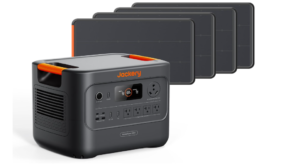
4)Jackery HomePower 3000 and 4x100W Prime Panels
Get it on Amazon
The Jackery HomePower 3000 and 4x100W Prime Panels offer a capable combination for camping trips where dependable off grid power is important. The HomePower 3000 delivers a 3600W output with 7200W surge capacity and a 3072Wh battery, giving you enough energy to run common essentials such as a refrigerator, fan, WiFi router, and lights. For camping, this large capacity can support several devices throughout the day while also providing useful backup power when access to traditional electricity is limited.
The 4x100W Prime Panels provide a convenient way to replenish the power station using solar energy while outdoors. Having four 100W panels gives campers more flexibility when setting up a solar charging system, especially during longer trips where access to a wall outlet may not be available. The system can also be recharged through AC and DC sources, including a 12V car charger and gas generator, giving you several options when weather conditions are not suitable for solar charging.
One of the most useful features for sensitive electronics and essential equipment is the ≤20ms UPS function. The UL certified UPS is designed to switch power quickly during an outage, helping connected devices continue operating without noticeable interruption. This can be particularly useful when using the power station for equipment such as security cameras, medical refrigerators, WiFi equipment, pet feeders, and other electronics that you do not want shutting down unexpectedly.
The HomePower 3000 also provides a broad selection of connection options for camping. AC, USB C, USB A, and DC ports allow several devices to be powered or charged at the same time. Its two 100W PD ports can provide fast charging for compatible phones, tablets, laptops, and drones, while the built in TT 30 RV port makes it practical for campers using an RV. This combination makes the power station suitable for both campsite equipment and everyday portable electronics.
Charging speed is another useful advantage for campers who need to replenish the battery quickly. Hybrid AC and DC charging can recharge the unit from 0 to 100% in about 1.7 hours, while AC charging takes around 2.2 hours. When paired with SolarSaga 200W panels, Jackery states that the unit can reach up to 80% charge in approximately 9 hours. The multiple charging methods make it easier to keep the power station available during extended outdoor trips.
Battery durability is supported by ChargeShield 2.0 technology, which uses AI based charging algorithms to improve charging performance and help extend battery life. The LiFePO4 battery is rated for 4,000 cycles while retaining 70% of its capacity. For frequent campers, this provides a useful combination of long term battery durability and dependable energy storage without relying entirely on conventional fuel powered generators.
Portability is another important consideration when choosing a camping power bank, and Jackery has focused heavily on reducing the size and weight of the HomePower 3000. The company describes it as the world’s first 3kWh portable power station using CTB technology, with 14% improved space efficiency. It is also claimed to be 47% smaller and 43% lighter than comparable models with the same capacity. The honeycomb style bottom shell adds structural strength and stability, while the integrated PV and inverter design helps make the system more compact and easier to manage outdoors.
For campers who need substantial battery capacity, multiple charging options, RV compatibility, fast charging, and solar recharging, the Jackery HomePower 3000 paired with 4x100W Prime Panels provides a versatile setup. Its 3072Wh capacity and high output make it capable of handling more than basic phone charging, while the solar panels provide a renewable way to replenish energy during longer camping trips. The combination is particularly useful for campers who want to operate larger appliances and several electronic devices without being tied to a conventional electrical outlet.
Pros
• 3600W output with 7200W surge capacity
• Large 3072Wh battery capacity for extended camping use
• 4x100W Prime Panels provide solar charging capability
• ≤20ms UPS helps maintain power during interruptions
• LiFePO4 battery rated for 4,000 cycles
• Multiple AC, USB C, USB A, and DC charging ports
• Dual 100W PD ports for compatible devices
• Built in TT 30 RV port
• Fast 1.7 hour hybrid AC and DC charging
• Supports AC, solar, 12V car, and gas generator charging
• Compact design compared with similar capacity power stations
• Useful for refrigerators, fans, WiFi equipment, lights, and other camping essentials
Cons
• The 3072Wh capacity and 3600W output may be more power than casual campers need
5)Jackery HomePower 3600 Plus with 2x200W Solar Panels
Get it on Amazon
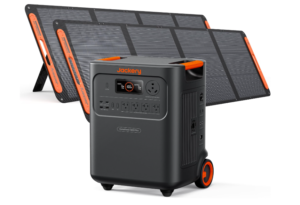
The Jackery HomePower 3600 Plus with 2x200W Solar Panels is a powerful option for campers who need more than basic portable charging. It combines a 3584Wh battery capacity with 3600W of output, giving you enough power to run demanding equipment such as pumps, heaters, and dryers. The system can also deliver up to 7200W when used in parallel, while its dual voltage capability supports both 120V and 240V applications, making it suitable for larger camping setups and emergency backup needs.
For extended trips, the 3584Wh capacity provides substantial energy storage, and the system can be expanded to as much as 21kWh per unit or 43kWh when multiple units are combined. This gives campers the flexibility to build a larger energy system when spending several days away from conventional electricity. The 2x200W Solar Panels also provide a renewable charging option, helping replenish the power station during the day without depending entirely on wall outlets or fuel.
Safety and battery longevity are important considerations for a high capacity camping power station, and the HomePower 3600 Plus uses high temperature resistant ceramic membrane battery cells. These cells have been tested at temperatures up to 302°F and are designed to help prevent thermal runaway caused by excessive heat or overcharging. The system is rated for up to 6,000 cycles and a 10 year lifespan, while its stated operating capability down to -4°F makes it suitable for demanding cold weather conditions.
The plug and play design makes the HomePower 3600 Plus easier to use than systems that require complicated installation. When paired with an MTS, it can provide backup power with a simple setup, allowing you to connect the system, press the power button, and keep essential equipment operating. For campers, this straightforward operation can be useful when setting up at a campsite or using the power station as backup power at an RV or temporary outdoor location.
Charging flexibility is another useful advantage. The HomePower 3600 Plus supports four charging methods, including hybrid AC and DC, standard AC, solar, and a gas generator. Hybrid AC and DC charging can take the battery from 0 to 100% in about 2 hours, while AC charging takes approximately 2.5 hours. Solar charging is rated at about 4 hours under suitable conditions, and a gas generator can also recharge the unit in around 2.5 hours. This range of options gives campers alternatives when sunlight, grid electricity, or fuel availability changes.
Portability is particularly important for camping equipment, and Jackery has designed the HomePower 3600 Plus to be easier to move than many power stations with similar capacity. It is described as the lightest 3.6kWh LFP power station and uses automotive grade CTB technology. The unit is 34% smaller and 29.3% lighter than comparable models according to Jackery, while its luggage style design includes wheels and a telescopic handle for rolling it between locations.
The combination of a large battery, high output, expandable capacity, and solar charging makes this system suitable for campers who operate several appliances or need power for longer periods. The 2x200W Solar Panels can help restore stored energy during the day, while the AC, hybrid, and generator charging options provide additional ways to keep the system ready when solar conditions are not ideal.
For camping, the Jackery HomePower 3600 Plus is designed for situations where a compact phone power bank is not enough. Its 3584Wh capacity can support larger appliances and multiple devices, while the 3600W output provides enough power for equipment that requires considerably more energy. The wheels and telescopic handle also make it more practical to transport around a campsite, RV area, garage, or home.
Pros
• 3600W continuous output with up to 7200W in parallel
• Large 3584Wh battery capacity
• Expandable up to 21kWh per unit
• Can reach up to 43kWh with multiple units
• Dual 120V and 240V voltage capability in parallel
• 2x200W Solar Panels provide renewable charging
• Four charging options for greater flexibility
• Hybrid AC and DC charging can reach 0 to 100% in about 2 hours
• LiFePO4 battery rated for up to 6,000 cycles
• Rated lifespan of up to 10 years
• High temperature resistant ceramic membrane battery cells
• Plug and play design when paired with MTS
• Wheels and telescopic handle improve portability
• 34% smaller and 29.3% lighter than comparable models according to Jackery
Cons
• Its high capacity may be more than casual campers need
You may also like to check Best Spotting Scope for the Smith & Wesson 1854
Best Camping Solar Power Bank Advantages
1. High Power Capacity
A high capacity power bank can store enough energy to run several camping essentials for extended periods. This is especially useful for powering refrigerators, lights, fans, routers, cooking equipment, and other appliances without needing to recharge constantly.
2. Solar Recharging
The ability to recharge through solar panels makes the system practical for extended outdoor trips. Instead of depending entirely on electrical outlets or fuel generators, you can use available sunlight to replenish the battery during the day.
3. Multiple Charging Options
Having several charging methods provides flexibility when camping in different environments. Depending on the system, you may be able to recharge through AC power, solar panels, a vehicle, or a generator, making it easier to maintain power when one source is unavailable.
4. Fast Charging
Fast recharge times reduce the amount of time you have to wait before using the power station again. This is particularly helpful during camping trips when you need to restore your stored energy quickly between activities or before nighttime.
5. Multiple Output Ports
A variety of AC, USB C, USB A, and DC ports allows you to power or charge several devices simultaneously. This means phones, tablets, cameras, laptops, lights, and compatible camping equipment can remain powered without requiring multiple separate chargers.
6. Long Lasting Battery Life
A durable LiFePO4 battery can provide thousands of charging cycles while maintaining a significant portion of its original capacity. This makes it suitable for frequent campers who expect to use their power station repeatedly over many years.
7. Portable Design
A power station designed with wheels, handles, or a compact construction is easier to move between your vehicle, campsite, cabin, or other outdoor locations. Portability is particularly valuable when the system has a large battery capacity.
8. Reliable Backup Power
A high output solar power bank can serve as more than just camping equipment. It can provide backup electricity during unexpected outages, helping keep essential appliances, communication devices, refrigerators, lights, and other important equipment running when conventional electricity is unavailable.
Factors to Consider When Choosing the Best Camping Solar Power Bank
1. Battery Capacity
Consider the battery capacity based on how long you expect to camp and what you plan to power. A larger capacity provides more stored energy for refrigerators, lights, fans, phones, laptops, and other equipment, while a smaller capacity may be sufficient for short trips with basic devices.
2. Power Output
Check the continuous power output and surge capacity before choosing a power bank. Higher output allows the system to operate more demanding appliances, while sufficient surge capacity helps accommodate devices that require extra power when starting.
3. Solar Charging Capability
Consider how efficiently the power bank can be recharged using solar panels. Look at the supported solar input and the type and wattage of panels included or compatible with the system to ensure it can replenish the battery effectively during your camping trip.
4. Charging Speed
A shorter recharge time can be valuable when you have limited access to electricity or sunlight. Consider how quickly the system can recharge through solar, AC power, a vehicle, or another available charging source.
5. Port Selection
Look for a suitable combination of AC, USB C, USB A, DC, and other outputs depending on the devices you normally take camping. Multiple ports allow you to charge or operate several devices at the same time without relying on additional adapters.
6. Battery Type and Lifespan
The battery chemistry affects durability, safety, weight, and overall service life. LiFePO4 batteries are commonly considered for portable power stations because they can support a high number of charging cycles and are designed for long term use.
7. Portability
Consider the power bank’s weight, size, handles, wheels, and overall design. A high capacity unit can be heavy, so features that make it easier to carry or roll can be especially useful when moving between your vehicle and campsite.
8. Safety and Reliability
Choose a system with appropriate battery protection and safeguards against issues such as overheating, overcharging, short circuits, and excessive loads. Reliable construction and protective technology are particularly important when the power bank will be used outdoors or as backup power for essential equipment.
Best Camping Solar Power Bank FAQs
1. How much battery capacity is needed for camping?
The right capacity depends on how many devices and appliances you plan to use and how long you will be away from an electrical outlet. A larger capacity is useful for extended trips or for running refrigerators, fans, lights, laptops, and other higher power equipment, while smaller units can work well for short trips and basic electronics.
2. Can a solar panel fully recharge a camping power bank?
Yes, a compatible solar panel system can recharge a camping power bank using sunlight. The actual charging time depends on the panel wattage, solar input supported by the power bank, sunlight intensity, weather, and panel positioning. Strong, direct sunlight generally provides better charging performance.
3. What should I look for in a camping power bank?
Consider battery capacity, continuous and surge power output, solar charging capability, recharge speed, available ports, battery lifespan, portability, and safety features. It is also important to choose a system that can provide enough power for the specific appliances and electronics you expect to use while camping.
Conclusion
Finding the best camping solar power bank comes down to choosing a system that matches the way you camp, whether you need basic charging for phones and lights or enough power to keep larger appliances running for longer periods.
A good option should combine sufficient battery capacity, strong power output, efficient solar charging, multiple ports, fast recharging, dependable battery life, and a design that remains practical to transport.
With the right balance of these features, a solar powered power bank can give you reliable energy while spending time away from traditional power sources, making your camping setup more flexible and prepared for changing conditions.