
Choosing the best battery for solar camping can make a major difference in how comfortably and reliably you stay powered while enjoying the outdoors. A good camping battery provides dependable energy storage, supports solar charging, and can power essential equipment when you are away from traditional electrical outlets.
The best options balance capacity, portability, durability, and power requirements to suit different camping setups and energy needs. In this guide, we will look at the important features to consider, highlight the top picks for solar camping, provide a practical buying guide to help you choose the right battery, and answer common questions in the FAQs section.
Best Battery for Solar Camping
1)Goal Zero Yeti 300 Portable Power Station

Get it on Amazon
The Goal Zero Yeti 300 Portable Power Station is a compact and capable option for campers who need dependable portable electricity away from traditional power sources. With 350 watts of AC power and up to 600 watts of surge capacity, it can handle useful camping equipment such as air pumps while also keeping phones, laptops, and other everyday electronics charged. Its portable design makes it practical for weekend camping trips, road trips, and off grid adventures where access to electricity may be limited.
One of the biggest advantages of the Yeti 300 is its LiFePO4 battery technology. The battery is rated for more than 4,000 cycles, giving it a potential lifespan of over 10 years with daily use. This makes it appealing for campers who want a power station designed for repeated use rather than something intended only for occasional emergencies. The battery chemistry also makes the unit a good choice for people looking for long term portable power.
Charging speed is another useful benefit when preparing for a camping trip. The Yeti 300 offers a high speed charging mode that can take the battery from 0% to 100% in about 50 minutes. This can be particularly convenient if you realize shortly before leaving that the power station needs charging. Instead of waiting several hours, you can recharge it while finishing your packing and getting ready to leave.
The Yeti 300 is also designed with outdoor use in mind. Its compact construction is made for durability, and it has passed particulate testing and UL2743 requirements. The IPX4 water resistance rating provides additional protection against water splashes, while its ability to operate in extreme temperatures makes it more suitable for changing outdoor conditions. Although it is still sensible to protect any electronic power station from heavy rain and direct water exposure, its construction provides useful reassurance for camping.
For off grid camping, the Yeti 300 can also be paired with a compatible solar panel through its solar charging port. This allows the power station to function as part of a solar generator setup, giving campers access to clean, renewable energy when sunlight is available. Solar charging can be especially useful during longer trips because you can replenish the battery during the day instead of depending entirely on wall charging.
Overall, the Goal Zero Yeti 300 combines useful power output, rapid charging, long battery life, durable construction, and solar charging capability in a compact package. Its 350 watt AC output makes it better suited to smaller camping appliances and electronics rather than high powered equipment, but for phones, laptops, air pumps, lights, and similar devices, it offers a practical source of portable power. For campers prioritizing longevity and fast recharge times, it is a strong option to consider.
Pros
• 350 W AC output with 600 W surge capacity
• LiFePO4 battery rated for 4,000+ cycles
• Potential lifespan of more than 10 years with daily use
• Charges from 0% to 100% in about 50 minutes using high speed charging
• Multiple charging and power ports
• Solar charging capability for off grid use
• IPX4 water resistance
• Designed to handle extreme temperatures
• Compact and portable design
Cons
• 350 W continuous AC output limits the appliances it can run
2)Goal Zero Yeti Portable Power Station – Yeti 1000X
Get it on Amazon
The Goal Zero Yeti 1000X Portable Power Station is a powerful option for campers looking for reliable battery storage for solar camping. With a 997 Wh capacity, it provides enough stored energy to run and recharge a wide range of everyday devices and smaller appliances. It can power phones, laptops, cameras, televisions, portable refrigerators, CPAP machines, WiFi routers, pellet grills, and other camping equipment, making it suitable for both short outdoor trips and longer off grid adventures.
The Yeti 1000X provides seven versatile ports, giving you different ways to power multiple types of devices. Its pure sine wave AC inverter delivers 1,500 watts of continuous power with up to 3,500 watts of surge capacity. This gives the power station the flexibility needed for devices with higher startup demands. For people who want to use it as part of a home backup system, it can also integrate directly into home circuits when paired with the Yeti Home Integration Kit, although that kit is not included.
Durability is another reason the Yeti 1000X works well for camping. It features a heavy duty anodized aluminum enclosure designed to withstand regular use, while its Tier 1 lithium battery cells provide dependable energy storage. The unit also operates quietly, making it much more comfortable around a campsite than a conventional gas generator. Since it produces no gas or toxic fumes during operation, it can provide cleaner and quieter power for outdoor activities.
Solar charging makes the Yeti 1000X particularly useful for extended camping trips. When paired with a compatible Goal Zero solar panel, the power station can be transformed into a solar generator. Its 600 watt MPPT charge controller helps optimize solar charging and can increase solar input by up to 30 percent. With sufficient sunlight and an appropriate solar panel setup, campers can replenish the battery during the day and continue using stored power when the sun goes down.
The 997 Wh capacity gives campers considerable flexibility when managing their power needs. You can use it to keep communication devices charged, operate entertainment equipment, power a portable refrigerator, or maintain essential equipment such as a CPAP machine. How long the battery lasts will depend on the devices connected and how much power they consume, but the capacity makes the Yeti 1000X more suitable for demanding camping setups than smaller portable power stations.
The package includes the Yeti 1000X power station, a wall charger, and a user guide, giving you the basic equipment needed to get started. Its combination of substantial battery capacity, multiple ports, quiet operation, durable construction, and solar charging capability makes it a practical choice for campers who want dependable electricity without carrying a fuel powered generator.
Pros
• 997 Wh battery capacity
• 1,500 W pure sine wave AC inverter
• Up to 3,500 W surge capacity
• Seven versatile ports
• Can power phones, laptops, TVs, cameras, portable fridges, and CPAP machines
• Heavy duty anodized aluminum enclosure
• Tier 1 lithium battery cells
• Quiet operation with no gas or toxic fumes
• 600 W MPPT charge controller
• Solar charging can increase solar input by up to 30 percent
• Can be used as a solar generator with a compatible Goal Zero solar panel
• Suitable for extended off grid camping
Cons
• Yeti Home Integration Kit is sold separately
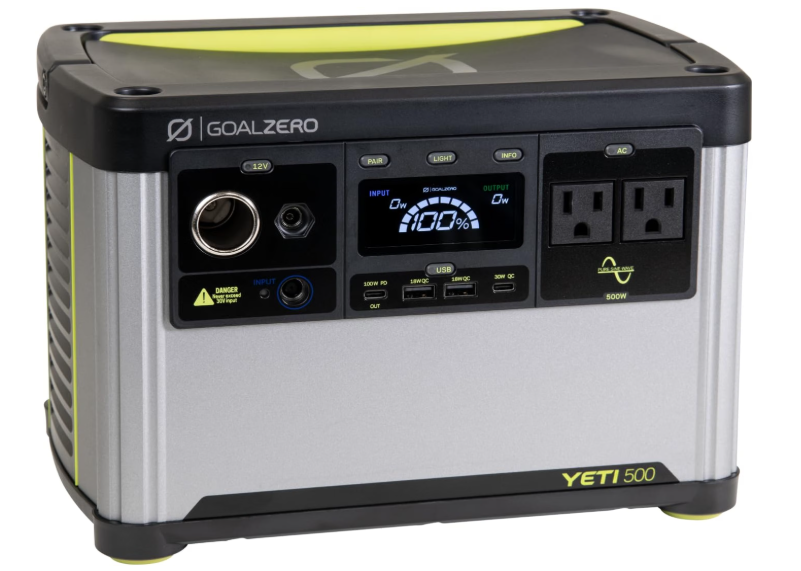
3)Goal Zero Yeti 500 Portable Power Station

Get it on Amazon
The Goal Zero Yeti 500 Portable Power Station is a practical choice for campers who need dependable battery power without relying on a traditional fuel generator. With 500 watts of AC output and up to 1,000 watts of surge power, it can run useful camping equipment such as air pumps, Alta portable fridges, and pellet grills. Its combination of portable power, long battery life, and solar charging makes it well suited to weekend camping and off grid adventures.
The Yeti 500 uses upgraded LiFePO4 battery technology, giving it a rated lifespan of more than 4,000 cycles. This translates to over 10 years of daily use under the stated conditions, making it a worthwhile option for frequent campers. The long cycle life also means the battery is designed for repeated charging and discharging rather than occasional emergency use.
Charging is particularly convenient when you are preparing for a trip. The Yeti 500 includes a high speed charging mode that can recharge the battery from 0% to 100% in approximately 90 minutes. This is useful when you have limited preparation time and need to get your power station ready before leaving for the campsite. The faster recharge also makes it easier to use the unit regularly without long waiting periods between charging sessions.
The Yeti 500 is built with outdoor use in mind. Its compact construction has passed particulate testing and UL2743 requirements, while an IPX4 rating provides protection against water splashes. It is also designed to handle extreme temperatures, which can be helpful when camping in changing weather conditions. While the IPX4 rating does not make the unit suitable for submersion or heavy direct exposure to water, it adds a useful level of protection for outdoor use.
Solar charging gives the Yeti 500 additional flexibility for longer camping trips. The power station includes a solar charging port, allowing you to connect a compatible solar panel and use the unit as a solar generator. With adequate sunlight, solar energy can replenish the battery during the day, providing a renewable way to maintain your power supply when you are away from electrical outlets.
For campers who need to operate smaller appliances and keep essential electronics powered, the Yeti 500 offers a balanced combination of capacity and portability. The 500 watt AC output provides enough power for several common camping devices, while the 1,000 watt surge capacity helps accommodate short startup demands. Its multiple ports also make it convenient for charging and powering different types of equipment.
Overall, the Goal Zero Yeti 500 is a versatile portable power station for solar camping. Its long lasting LiFePO4 battery, 90 minute high speed charging, durable construction, water resistance, and solar charging capability make it suitable for campers who want reliable electricity without fuel, fumes, or excessive noise.
Pros
• 500 W AC power output
• 1,000 W surge capacity
• LiFePO4 battery technology
• More than 4,000 battery cycles
• Designed for over 10 years of daily use
• High speed charging from 0% to 100% in about 90 minutes
• Can run air pumps, portable fridges, and pellet grills
• Multiple ports for different devices
• IPX4 water resistance
• Designed to handle extreme temperatures
• Solar charging capability
• Can function as a solar generator for off grid camping
Cons
• 500 W continuous output limits the size of appliances it can power
4)Goal Zero Yeti 700 Portable Power Station
Get it on Amazon
The Goal Zero Yeti 700 Portable Power Station is a strong choice for campers who want reliable battery power for appliances and equipment while spending time off the grid. It delivers 600 watts of AC power with up to 1,000 watts of surge capacity, allowing it to run useful camping equipment such as power tools, Alta portable fridges, and pellet grills. This combination makes it suitable for campers who need more capability than a basic power bank can provide.
The Yeti 700 uses upgraded LiFePO4 battery technology, which is designed for a long service life. With more than 4,000 charge cycles, the battery is rated for over 10 years of daily use. This makes the power station a practical option for frequent campers who expect to recharge and use their unit regularly. The long cycle life also provides better value for users who want a portable power source they can rely on for years.
Charging the Yeti 700 is relatively convenient when preparing for a camping trip. Its high speed charging mode can take the battery from 0% to 100% in about two hours. This can be helpful when you have forgotten to charge the unit ahead of time or need to prepare it shortly before leaving. Faster charging also means less time waiting between uses when you have access to an electrical outlet.
Durability is another useful quality for outdoor use. The compact power station is designed with durability in mind and has passed particulate testing and UL2743 requirements. It also carries an IPX4 water resistance rating and is designed to handle extreme temperatures. While IPX4 protection does not mean the power station can be submerged or exposed to heavy water, it offers some protection against splashes and typical outdoor conditions.
The Yeti 700 can also become a solar generator when connected to a compatible solar panel. Its dedicated solar charging port allows campers to replenish the battery using sunlight, providing a cleaner and renewable source of electricity away from the grid. This is particularly useful for longer camping trips because solar charging can help extend the time you can stay away from conventional electrical outlets.
Multiple ports add flexibility when powering different types of equipment. Instead of relying on a single connection, you can use the available ports for various devices and camping accessories. The 600 watt AC output is useful for equipment within its power range, while the 1,000 watt surge capacity can accommodate short bursts of higher power demand during startup.
Overall, the Goal Zero Yeti 700 is a versatile portable power station for solar camping. Its LiFePO4 battery, 4,000 plus cycle lifespan, two hour high speed charging, 600 watt AC output, durable construction, and solar charging capability make it well suited to campers who want dependable power without fuel or toxic fumes.
Pros
• 600 W AC power output
• 1,000 W surge capacity
• Long lasting LiFePO4 battery technology
• More than 4,000 battery cycles
• Designed for over 10 years of daily use
• High speed charging from 0% to 100% in about two hours
• Can run power tools, portable fridges, and pellet grills
• Multiple ports for powering different devices
• IPX4 water resistance
• Designed to handle extreme temperatures
• Dedicated solar charging port
• Can function as a solar generator for off grid camping
Cons
• 600 W continuous output limits the appliances it can power
5)EX-G27-100C
Get it on Amazon
The EX-G27-100C is a 100Ah battery designed to provide dependable stored power for solar camping and other off grid applications. With a 100Ah capacity, it offers a substantial amount of energy storage for campers who need to keep essential equipment running when conventional electrical outlets are unavailable. Its focus on optimizing power and performance makes it a practical option for building a reliable camping power system.
With a 100Ah capacity, the EX-G27-100C can provide useful energy for a range of camping needs when paired with a suitable solar charging setup and compatible equipment. The available runtime will depend on the power requirements of the devices connected, but the capacity gives campers plenty of flexibility for managing their energy throughout a trip. It can be particularly useful as part of a larger solar battery system where consistent energy storage is important.
Portability is another consideration for camping applications. The battery weighs 29.8 pounds, making it reasonably manageable for its capacity, although it is heavier than many smaller portable power stations. Its dimensions measure 11.93 by 6.81 by 8.82 inches, giving it a relatively compact rectangular form that can fit into appropriately sized camping, RV, or solar power setups.
The EX-G27-100C is best suited to campers who prioritize battery capacity and practical installation rather than an all in one portable power station. Unlike a power station with built in outlets and charging electronics, a standalone battery generally needs compatible supporting equipment to deliver power to specific devices. This makes it important to consider the rest of your solar setup when determining whether this battery meets your needs.
Overall, the EX-G27-100C offers a straightforward combination of 100Ah capacity and compact dimensions for solar camping applications. Its 29.8 pound weight is worth considering when portability is important, but the substantial capacity can make it useful for campers looking to store solar energy for later use.
Pros
• 100Ah capacity
• Designed to optimize power and performance
• Suitable for solar camping applications
• Compact dimensions of 11.93 by 6.81 by 8.82 inches
• Reasonable weight for a 100Ah battery
• Can provide substantial energy storage for off grid setups
Cons
• Weighs 29.8 pounds
You may also like to read Best Solar Panel for Camper Van
Best Battery for Solar Camping Advantages
1. Reliable Energy Storage
A suitable solar camping battery provides dependable energy storage for use when sunlight is unavailable. This allows campers to store power generated during the day and use it later for essential devices, lighting, refrigeration, and other camping equipment.
2. Higher Capacity
Choosing a battery with a suitable capacity gives you more stored energy for longer camping trips. A higher capacity can reduce the need for frequent recharging and make it easier to manage power when access to electricity is limited.
3. Better Off Grid Convenience
A good battery makes off grid camping more convenient by providing a dependable source of stored electricity. When combined with solar panels and compatible equipment, it can help reduce reliance on electrical outlets and traditional power sources.
4. Useful for Different Camping Needs
The right battery can support a variety of camping equipment depending on its capacity and the rest of the power system. This flexibility makes it useful for powering essential electronics, portable refrigerators, lighting, and other equipment while away from home.
5. Practical Portability
A battery that balances capacity and weight can be easier to transport and install in a camping or RV setup. Compact dimensions are also helpful when storage space is limited, allowing campers to make better use of the available space.
6. Supports Solar Charging
A suitable battery can work as part of a solar charging system, allowing energy collected from solar panels to be stored for later use. This makes it possible to take advantage of renewable energy throughout a camping trip.
7. Long Term Power Solution
Choosing a battery designed for regular use can provide a practical long term solution for campers who frequently travel off grid. Having dependable energy storage can make repeated camping trips easier without needing to rely entirely on external power sources.
8. Greater Power Independence
A quality solar camping battery gives campers more control over their available electricity. By storing solar energy and making it available when needed, it can provide greater independence and help campers stay powered in locations without convenient access to the electrical grid.
Factors to Consider When Choosing the Best Battery for Solar Camping
1. Battery Capacity
Battery capacity determines how much energy the battery can store for later use. For solar camping, consider how many devices you plan to power and how long you will be away from a reliable electrical source. A higher capacity can provide longer operating times and reduce the need for frequent recharging.
2. Weight
Weight is important when transporting equipment to a campsite or moving a battery between different locations. A battery should provide enough storage capacity without becoming unnecessarily difficult to carry. Consider the balance between energy storage and portability based on your camping setup.
3. Size and Dimensions
The physical size of a battery can affect where you can install or store it. Compact dimensions are particularly useful in tents, campers, RVs, and other spaces where storage room is limited. Always measure the available space before choosing a battery.
4. Compatibility With Solar Panels
Make sure the battery is compatible with the solar panels and charging equipment you intend to use. Proper compatibility helps ensure that solar energy can be transferred efficiently into the battery and stored for later use.
5. Power Requirements
Consider the type and number of devices you expect to operate from the battery. Phones, lights, portable refrigerators, laptops, and other equipment can have different power requirements. Choosing a battery that matches your intended energy needs can help prevent insufficient power during your trip.
6. Portability
A portable battery should be practical to move, install, and use at different camping locations. Consider its weight, size, and how easily it can be transported alongside your other camping equipment, especially if you regularly change campsites.
7. Durability
Camping batteries may be exposed to transportation, changing temperatures, dust, moisture, and general outdoor conditions. A durable construction can make a battery more suitable for regular outdoor use and help it remain dependable during different camping trips.
8. Intended Camping Setup
Think about whether you need a standalone battery for a customized solar system or a more complete power solution. A standalone battery may require additional equipment to deliver power to your devices, so consider the complete setup, including solar panels, charging equipment, and compatible power outlets, before making a choice.
Best Battery for Solar Camping FAQs
1. What battery capacity is best for solar camping?
The ideal battery capacity depends on how much equipment you plan to power and how long you will be camping. A higher capacity is generally better for longer trips or for running several devices, while a smaller capacity can be sufficient for basic needs such as lights, phones, and small electronics.
2. Can a solar camping battery be charged with solar panels?
Yes, a compatible battery can be charged using solar panels as part of a suitable solar power system. It is important to check that the battery and solar charging equipment are compatible so that the battery receives the appropriate charging power.
3. What should I consider when choosing a battery for solar camping?
Consider capacity, weight, dimensions, portability, power requirements, durability, and compatibility with your solar panels and other equipment. Choosing a battery based on your actual camping power needs can help provide reliable energy without carrying more weight or capacity than necessary.
Conclusion
The best battery for solar camping is one that matches your energy needs, camping style, and available solar setup rather than simply offering the highest capacity. A well chosen battery should provide enough stored power for your essential equipment while remaining practical to transport, install, and recharge.
Capacity, portability, durability, power requirements, and solar compatibility all play an important role in finding the right option. With these factors in mind, campers can choose a dependable energy storage solution that makes off grid adventures more comfortable, convenient, and less dependent on traditional electricity.