
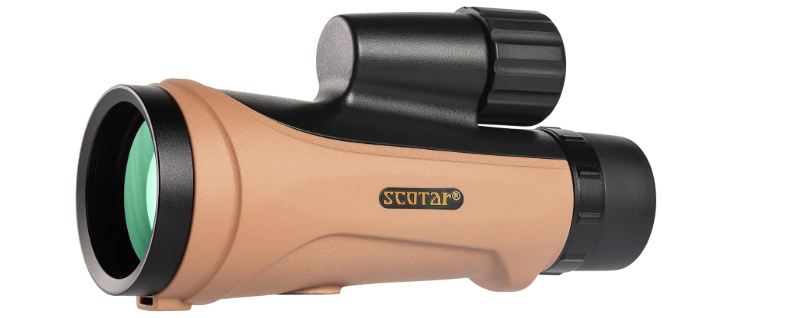
The best monocular for bird watching with a camera combines powerful magnification, quality optics, portability, and smartphone compatibility to make distant birds easier to observe and photograph. These monoculars are great for birders who want to see fine details such as feather patterns, colors, and natural behavior while also capturing photos or videos without carrying bulky camera equipment.
Features such as large objective lenses, multi-coated optics, waterproof construction, comfortable focusing, tripod support, and smartphone adapters can make outdoor viewing more enjoyable and practical. In this guide, we’ll explore the key features to look for, highlight the top picks, provide a helpful buying guide to make your choice easier, and answer common FAQs about using a monocular for bird watching and smartphone photography.
Best Monocular for Bird Watching With Camera
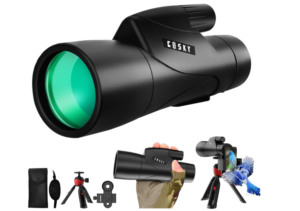
1)Gosky 15×55 Monocular
Get it on Amazon
The Gosky 15×55 Monocular is a strong option for bird watchers who want powerful magnification with the added convenience of smartphone photography. Its 15x magnification brings distant birds noticeably closer, making it easier to observe plumage, movement, and other fine details from a distance. The 315-foot field of view also helps you locate and follow birds more comfortably instead of making the high magnification feel overly restrictive.
Its 55mm objective lens is particularly useful for outdoor observation. The large lens gathers more available light, while the 4.58mm exit pupil provides a fuller beam of light to the eye. This combination helps maintain a bright, comfortable image during daylight, cloudy conditions, shaded areas, and even around dawn or dusk. For birders who spend long periods outdoors, the larger optical system can make viewing less tiring.
Optical performance is supported by an 18mm BAK4 prism and fully multi-coated optics. These components are designed to improve light transmission and image contrast while reducing reflections. The result is clearer detail and more natural-looking colors, which can be helpful when distinguishing birds against foliage or spotting subtle features at longer distances.
Outdoor durability is another advantage. The Gosky 15×55 has an IPX7 waterproof design that helps protect the internal optics from rain, splashes, and moisture. Its nitrogen-filled construction helps reduce internal fogging when temperatures change, while the rubber armor provides additional impact protection and a more secure grip. This makes it well suited to birding trips, wildlife observation, hiking, and other outdoor activities where weather conditions can change quickly.
The included tripod is especially useful because 15x magnification can make even small hand movements noticeable. Mounting the monocular on the tripod provides a steadier view during longer observation sessions. The smartphone adapter adds another useful capability, allowing compatible phones to be aligned with the eyepiece so you can capture photos and videos of distant birds. For bird watchers who want both visual observation and smartphone recording, this combination makes the Gosky more versatile than a basic handheld monocular.
Pros
• 15x magnification brings distant birds and wildlife closer
• 315-foot field of view makes it easier to locate and track moving subjects
• Large 55mm objective lens helps gather more available light
• 4.58mm exit pupil supports a bright and comfortable viewing experience
• 18mm BAK4 prism helps improve image quality and detail
• Fully multi-coated optics enhance light transmission and contrast
• IPX7 waterproof construction provides useful protection in wet conditions
• Nitrogen-filled body helps reduce internal fogging
• Rubber armor improves grip and adds impact protection
• Included tripod helps stabilize the powerful 15x view
• Smartphone adapter allows users to capture photos and videos
Cons
• 15x magnification can be difficult to hold completely steady without the tripod
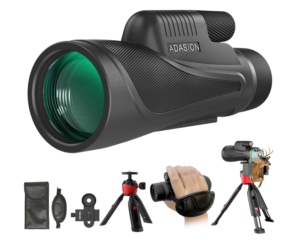
2)Adasion 15×56 Monoculars
Get it on Amazon
The Adasion 15×56 Monoculars are designed for bird watchers who want powerful magnification, bright optics, and a practical design for outdoor use. With 15x magnification and a large 56mm objective lens, this monocular makes distant birds appear closer while helping reveal finer details. It can also be useful for wildlife spotting, camping, hiking, sightseeing, and viewing events where extra magnification is beneficial.
The large 56mm lenses help gather more available light, making the viewing experience brighter and clearer, particularly when lighting conditions are less than ideal. This can be valuable for bird watching in shaded woodland, overcast weather, or during the early and later parts of the day when birds are often active. The high magnification provides plenty of reach for observing subjects at a distance without needing to move closer.
The fully multi-coated optical system is another important part of the viewing experience. Advanced coatings are designed to improve light transmission while supporting higher contrast and clearer images. Dielectric and phase coatings further contribute to true-color viewing, helping birds appear more natural rather than washed out or overly tinted. This combination makes the monocular suitable for users who care about seeing fine details and realistic colors.
Focusing is designed to be straightforward, with a smooth focus knob that allows precise adjustments. The ability to make quick changes with one hand is useful when a bird suddenly moves from one branch to another or when you need to refocus at a different distance. A responsive focusing system can make a noticeable difference when observing active wildlife because there is less time spent struggling with the controls.
The Adasion 15×56 also has features intended for outdoor conditions. Its IPX7 waterproof construction provides protection against rain and accidental exposure to water, while the fog-proof design helps maintain visibility when conditions change. The included hand strap adds carrying convenience and gives you a more secure grip while walking or hiking. Although the 15x magnification benefits from steady handling, the hand strap can make the monocular more comfortable to manage during extended outdoor use.
With its combination of strong magnification, large optics, weather protection, and easy focusing, the Adasion 15×56 is a versatile choice for bird watchers who want more reach than a basic compact monocular can provide. It is also a practical option for outdoor enthusiasts looking for one optical device that can serve several purposes.
Pros
• 15x magnification provides a close view of distant birds and wildlife
• Large 56mm objective lenses help gather more available light
• Fully multi-coated optics support brighter and clearer images
• Dielectric and phase coatings help produce high-contrast, true-color views
• Smooth focus knob allows precise adjustments
• One-hand focusing is convenient when tracking moving birds
• IPX7 waterproof construction is suitable for wet outdoor conditions
• Fog-proof design helps maintain visibility when temperatures change
• Portable hand strap improves carrying convenience and grip
• Suitable for bird watching, wildlife spotting, camping, hiking, and sightseeing
Cons
• 15x magnification can be harder to keep steady when used handheld
3)Scotar 12×50 Monocular Telescope
Get it on Amazon
The Scotar 12×50 Monocular Telescope is a versatile choice for bird watchers who want a combination of detailed viewing and smartphone photography. Its 12x magnification brings distant birds closer without going as far as some higher-powered monoculars, making it a practical balance between reach and ease of use. The 50mm objective lens also provides a wide optical opening, while the claimed 85% light transmission helps produce a bright and detailed image during outdoor observation.
The fully multi-coated optical system is designed to maintain image clarity in changing conditions. Its BAK4 prism features phase and dielectric coatings, which are intended to improve light transmission, contrast, and color accuracy. This makes the Scotar suitable for observing birds, wildlife, landscapes, and even stars when conditions are appropriate. The IP67 construction adds protection against dust and water, while its fog-proof design helps maintain a clear view when weather conditions become challenging.
One of the most useful aspects for bird watchers is the smartphone setup. The Scotar includes a smartphone adapter and mini tripod, allowing you to mount your phone behind the eyepiece and capture photographs or videos of what you are viewing. The adapter is designed to hold the phone securely and align it with the monocular, which can make smartphone photography more convenient than trying to hold both devices separately.
The included accessories also make the package more practical for outdoor use. Along with the monocular, you get a carrying pouch, smartphone adapter, and mini tripod. The tripod can provide additional stability when using 12x magnification, particularly when photographing stationary birds or observing a subject for an extended period. The ergonomic design is intended to provide a comfortable grip while the stable mounting system helps reduce unwanted movement during smartphone photography.
Durability is another area where the Scotar aims to be more than a basic compact monocular. The body is designed to withstand a drop of up to 1.5 meters onto sand and is rated for temperatures from -4°F to 140°F (-20°C to +60°C). It also has vibration resistance and a nitrogen-filled body intended to reduce internal condensation during significant temperature changes. These features make it a reasonable option for bird watchers who regularly explore different outdoor environments.
The Scotar 12×50 is particularly appealing to beginners and amateur observers who want an all-in-one setup rather than purchasing a monocular, phone adapter, and tripod separately. Its combination of 12x magnification, 50mm optics, weather protection, smartphone compatibility, and included accessories gives bird watchers a flexible setup for viewing and recording wildlife.
Pros
• 12x magnification provides useful reach for distant birds and wildlife
• 50mm objective lens provides a large optical opening for outdoor viewing
• Claimed 85% light transmission supports bright and detailed images
• FMC optics help improve light transmission and image clarity
• BAK4 prism with phase and dielectric coatings supports contrast and color accuracy
• IP67 protection helps defend against dust and water
• Fog-proof construction is useful in changing weather conditions
• Includes a smartphone adapter for taking photos and videos
• Mini tripod provides additional stability for observation and photography
• Carrying pouch makes transportation more convenient
• Ergonomic body is designed for comfortable handheld use
• Nitrogen-filled construction helps reduce internal condensation
• Designed to withstand a 1.5-meter drop onto sand
• Supports use across a broad range of temperatures
• Limited lifetime support adds reassurance for long-term ownership
Cons
• 12x magnification can still be difficult to hold completely steady without tripod support
4)Mocanio 10–30×50 Zoom Monoculars
Get it on Amazon
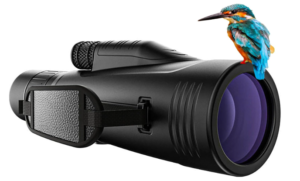
The Mocanio 10–30×50 Zoom Monoculars are a flexible option for bird watchers who want adjustable magnification and smartphone photography in one compact setup. Instead of being limited to a single magnification level, this monocular lets you move from 10x to 30x depending on how far away the bird is. The 50mm objective lens provides a generous optical opening, making it useful for bird watching, wildlife observation, sightseeing, travel, and other outdoor activities.
The adjustable 10–30x zoom range gives users more control over how they observe distant subjects. At lower magnification, it can be easier to locate and follow a moving bird, while increasing the magnification can help bring a distant subject closer for more detailed observation. The closest focusing distance is listed at 2.6 meters, making it suitable for observing subjects at relatively close distances as well as those farther away.
Focusing is designed with convenience in mind. The ergonomic body and single-hand focusing system allow users to make quick adjustments while keeping the monocular comfortably in position. The focusing handwheel is designed for precise control, which can be useful when a bird suddenly changes position or when you need to fine-tune the image before taking a photograph. The comfortable grip also helps when holding the monocular for longer viewing sessions.
The optical system uses a BAK4 prism along with FMC broadband coatings. The objective lens features a multilayer broadband green film, while the eyepiece uses blue FMC coating. These optical coatings are intended to improve light transmission and image quality, helping produce a clearer and more detailed view. For bird watchers, this can be helpful when trying to distinguish birds against trees, grass, or other visually busy backgrounds.
The Mocanio also includes features aimed at outdoor use. Its waterproof materials, anti-fog coating, and protective optics are designed to help keep water, dust, and fog from interfering with viewing. The monocular is also described as offering low-light night vision capabilities, giving it additional versatility when observing in dimmer conditions. However, users should not expect it to perform like a dedicated night-vision device.
Smartphone compatibility adds another practical advantage. The included phone holder is designed to work with many types of smartphones, allowing users to capture photos and videos through the monocular. The design also accommodates eyeglass wearers by allowing them to position their eyes closer to the eyepiece more comfortably. Its broad usability makes it suitable for both adults and children under appropriate supervision.
The Mocanio 10–30×50 is a good fit for bird watchers who value flexibility more than having a fixed magnification. Its zoom capability, smartphone holder, ergonomic focusing system, weather-resistant design, and coated optics create an adaptable setup for observing and recording birds. The lifetime warranty also provides additional reassurance for buyers who plan to use the monocular regularly.
Pros
• Adjustable 10–30x magnification provides flexibility for different viewing distances
• 50mm objective lens offers a large optical opening for outdoor observation
• 2.6-meter closest focusing distance supports relatively close subjects
• Single-hand focusing allows quick and convenient adjustments
• Ergonomic design provides a comfortable grip
• BAK4 prism supports image quality and light transmission
• FMC broadband coatings are designed to improve clarity and viewing performance
• Waterproof construction helps protect against wet outdoor conditions
• Anti-fog features help maintain visibility in changing weather
• Smartphone holder allows users to capture photos and videos
• Designed to accommodate many smartphone types
• Eyeglass-friendly design provides more comfortable viewing
• Suitable for adults and children
• Lifetime warranty provides additional buyer reassurance
Cons
• 30x magnification can make handheld viewing more difficult because small movements become more noticeable
5)Monocular Telescope 12×56 High Powered
Get it on Amazon
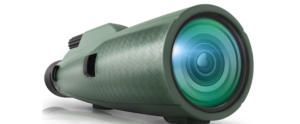
The Monocular Telescope 12×56 High Powered is a versatile option for bird watchers who want strong magnification without carrying a bulky optical setup. With 12x magnification and a large 56mm objective lens, it brings distant birds and wildlife closer while providing a detailed view. The combination is also useful for stargazing, sightseeing, hiking, hunting, and other outdoor activities where extra viewing range is helpful.
The 56mm lens gives this monocular a substantial optical opening, which can be beneficial when observing subjects in varying light conditions. The 12x magnification offers a useful balance between reach and practical handheld viewing, allowing bird watchers to examine distant subjects without relying on extremely high magnification. It can be especially useful when watching birds in open fields, wetlands, forests, or other locations where getting physically closer is difficult.
For bird watchers who enjoy taking photos, the included smartphone adapter adds another layer of versatility. The adapter allows a compatible smartphone to be positioned behind the eyepiece so users can capture photos and videos of wildlife, landscapes, and other distant subjects. This makes the monocular more than a viewing instrument, particularly for users who want to document their birding trips without investing in a dedicated camera system.
The adjustable tripod is also useful when observing for extended periods or photographing stationary birds. At 12x magnification, even small hand movements can affect the image, so mounting the monocular can provide a steadier viewing platform. The combination of the tripod and phone adapter creates a convenient setup for users who want to switch between handheld observation and more stable smartphone photography.
Durability is another consideration for outdoor users. The monocular features a waterproof ABS body and a metal bracket interface designed to withstand demanding environments. This rugged construction makes it suitable for hiking, travel, wildlife observation, and other activities where the equipment may encounter rough handling or changing weather conditions.
Despite its high-powered optical design, the monocular remains relatively portable. At 14.8 ounces, or approximately 420 grams, it is light enough to carry on hikes, trips, or outdoor excursions without adding excessive weight to your gear. Its compact design makes it particularly appealing to bird watchers who want a capable monocular that can be carried easily throughout the day.
Overall, the Monocular Telescope 12×56 High Powered offers a practical combination of magnification, smartphone compatibility, stability, durability, and portability. It is a good choice for bird watchers who want to observe distant wildlife and capture their experiences with a smartphone while keeping their outdoor equipment relatively simple.
Pros
• 12x magnification brings distant birds and wildlife closer
• Large 56mm objective lens provides a generous optical opening
• Suitable for bird watching, wildlife observation, stargazing, hiking, and travel
• Included smartphone adapter supports photos and videos through the eyepiece
• Adjustable tripod provides additional stability for extended observation
• Waterproof ABS body is designed for outdoor conditions
• Metal bracket interface adds durability to the mounting system
• Lightweight design weighs approximately 420 grams
• Compact construction makes it convenient to carry during outdoor activities
• Smartphone setup provides an affordable way to document wildlife observations
Cons
• 12x magnification can still be difficult to hold completely steady for photography
You may also like to check Best Lightweight Monocular for Bird Watching
Advantages of Choosing the Best Monocular for Bird Watching With Camera
Powerful Magnification
A quality monocular for bird watching provides enough magnification to bring distant birds closer without requiring you to physically approach them. Magnification in the 10x to 15x range can help reveal details such as feather patterns, colors, body markings, and behavior while allowing you to observe birds from a respectful distance. This is especially useful in open habitats, wetlands, forests, and other areas where birds may remain far away.
Large Objective Lens
A larger objective lens allows more available light to enter the optical system, helping produce a brighter and more comfortable image. This can be particularly beneficial when bird watching in shaded areas, overcast weather, or during the early morning and late afternoon. A larger lens can also make it easier to appreciate fine details without depending entirely on extremely high magnification.
Smartphone Photography
A monocular with a smartphone adapter allows you to turn your phone into a convenient wildlife camera. Once the phone is properly aligned with the eyepiece, you can capture photographs and videos of birds you are observing. This is a major advantage for bird watchers who want to document sightings, share interesting moments, or keep a personal record of different species without carrying a separate camera and telephoto lens.
High Quality Optical Coatings
Fully multi-coated optics and quality prism coatings can improve light transmission, contrast, and image clarity. Better optical performance helps produce more natural colors and sharper details, which are important when identifying birds by their appearance. Clearer optics can also make prolonged observation more enjoyable because the image is easier to study.
Steady Viewing and Photography
A tripod-compatible monocular provides greater stability, which becomes increasingly valuable at higher magnifications. Even small movements can make a distant bird appear to shake or move across the field of view. Using a tripod can create a steadier image for extended observation and make smartphone photography easier, particularly when photographing birds that remain in one position.
Weather Protection
Waterproof, dustproof, and fog-resistant construction provides greater confidence when using a monocular outdoors. Bird watching often takes place in unpredictable conditions, so protection against rain, moisture, dust, and internal fogging can help keep the optics usable. This makes a weather-resistant design particularly valuable for birders who regularly explore different environments.
Comfortable Focusing
A smooth and responsive focusing mechanism makes it easier to quickly bring birds into sharp view. Birds can move unexpectedly, so a focusing system that can be adjusted easily with one hand can save valuable time. Comfortable controls also reduce frustration during longer observation sessions and help you concentrate more on the bird rather than the equipment.
Portable Design
A lightweight and compact monocular is easier to carry during hikes, nature walks, travel, and extended birding trips. Portability means you can keep the optic readily available instead of leaving it behind because your gear is too heavy. A well-designed portable model can provide useful magnification while remaining convenient enough for regular outdoor use.
Versatile Outdoor Use
A good bird-watching monocular can serve purposes beyond observing birds. The same optical equipment can be useful for wildlife spotting, landscapes, sightseeing, hiking, camping, sporting events, and even basic stargazing. Choosing a versatile model can therefore provide greater value because one device can support several outdoor interests.
Durable Construction
A sturdy body can withstand the demands of regular outdoor use, including accidental knocks and exposure to challenging environments. Rugged materials and protective rubber armor can improve grip while adding another layer of protection around the optical components. This is especially useful for bird watchers who frequently travel through trails, forests, or uneven terrain.
Comfort for Eyeglass Wearers
An eyeglass-friendly design can make a significant difference in viewing comfort. Features such as suitable eye relief allow users wearing glasses to position their eyes correctly without constantly removing their eyewear. This makes extended bird watching more comfortable and helps ensure that the entire viewing field remains accessible.
Better Low-Light Observation
Birds are often active during early mornings and late afternoons, when natural light is weaker. A combination of a large objective lens and efficient optical coatings can help maintain a brighter image during these periods. Although a monocular is not a substitute for dedicated night vision equipment, good light-gathering performance can make it considerably more useful when daylight begins to fade.
Included Accessories
Accessories such as smartphone adapters, tripods, carrying pouches, and hand straps can make a monocular more practical straight out of the box. Having these items included reduces the need to purchase compatible accessories separately and gives beginners a more complete bird-watching setup. The right accessories can also improve stability, portability, and photography convenience.
Factors to Consider When Choosing the Best Monocular for Bird Watching With Camera
1. Magnification
Consider the magnification carefully because it determines how close distant birds appear. A range around 10x to 15x can provide useful reach for bird watching while remaining practical for locating and following moving subjects. Extremely high magnification can make the image more difficult to keep steady, so it is important to balance viewing distance with ease of use.
2. Objective Lens Size
The objective lens affects how much light enters the monocular and can influence image brightness and viewing comfort. Larger lenses generally gather more light, which can be helpful during cloudy weather, in shaded forests, or during early morning and late afternoon bird watching. However, larger lenses can also increase the overall size and weight, so consider how much portability you need.
3. Optical Quality and Coatings
Look for quality prisms and fully multi-coated optical surfaces because they can improve light transmission, contrast, sharpness, and color accuracy. Good optics are particularly important for bird identification, where small details such as feather patterns, markings, and colors may determine the species. Better optical quality can also provide a more comfortable viewing experience during longer sessions.
4. Smartphone Compatibility
If taking photos and videos is a priority, check whether the monocular comes with a reliable smartphone adapter and whether it works with your phone. Proper alignment between the phone camera and eyepiece is essential for producing usable images. A secure adapter should hold the phone firmly and make it reasonably easy to center the camera without constant adjustment.
5. Stability and Tripod Support
Higher magnification makes hand movement more noticeable, which can affect both observation and smartphone photography. A tripod mount or included tripod can provide a much steadier image, especially when watching a stationary bird for several minutes or capturing photographs. Consider whether the mounting system is secure and whether it is compatible with other tripod equipment you may already own.
6. Weather Resistance and Durability
Bird watching frequently takes place outdoors, where rain, moisture, dust, and changing temperatures are common. Waterproof, fog-resistant, and dust-resistant construction can help protect the internal optics and maintain clear viewing conditions. A durable body with protective materials can also be beneficial if you regularly hike through rough terrain or travel with your equipment.
7. Focus System and Ease of Use
A smooth, responsive focus mechanism makes it easier to bring birds into sharp view quickly. This is particularly important when observing active species that move between branches or suddenly change distance. An ergonomic design and easy-to-operate focusing controls can also reduce hand fatigue and make extended viewing more comfortable.
8. Weight, Portability, and Accessories
Consider the monocular’s overall weight and size based on how you plan to use it. A lightweight design is easier to carry on long walks, hikes, and birding trips, while a larger optical system may provide better light gathering at the cost of portability. Also consider useful accessories such as a carrying pouch, hand strap, tripod, and smartphone adapter, as these can make the complete setup more convenient and versatile.
Best Monocular for Bird Watching With Camera FAQs
1. Which magnification is best for bird watching with a camera?
A magnification between 10x and 15x is generally a good choice for bird watching with a smartphone. It provides enough reach to observe distant birds while remaining easier to focus and stabilize than extremely high magnification. Higher magnification can reveal more detail, but it also makes hand movement more noticeable, so tripod support can be particularly useful.
2. Can I take clear bird photos through a monocular with my smartphone?
Yes, provided the monocular and smartphone adapter are properly aligned. A secure adapter positions the phone camera behind the eyepiece, allowing you to capture images and videos of distant birds. For the best results, use a tripod or another stable surface, carefully center the phone camera, and focus the monocular before taking the photograph.
3. What should I look for in a monocular for bird watching and smartphone photography?
Prioritize good optical quality, suitable magnification, a large objective lens, smartphone compatibility, and stable mounting. Fully multi-coated optics and quality prisms can help produce brighter, sharper, and more natural-looking images, while waterproof construction is useful for outdoor birding. A tripod and reliable phone adapter are also valuable if photography is an important part of your bird-watching experience.
Conclusion
Choosing the best monocular for bird watching with a camera is ultimately about finding the right balance between magnification, optical clarity, stability, portability, and smartphone convenience. A good model should bring distant birds into clear view while giving you a practical way to capture those moments on your phone.
Large objective lenses, quality coated optics, weather protection, comfortable focusing, and tripod compatibility can all make a noticeable difference in the field. Whether you are a casual nature enthusiast or a dedicated birder, the right monocular can turn ordinary outdoor walks into opportunities for closer observation and memorable wildlife photography.